A standard upright piano weighs between 300 and 800 pounds, but weight alone does not explain why a general moving crew cannot safely handle one. The mass is distributed unevenly across the frame, concentrated toward the top of the instrument. When tilted to clear a doorway or navigate a staircase landing, the center of gravity shifts in a way that is counterintuitive even to experienced furniture movers. The instrument pulls forward and away from the handlers. The legs on any upright are the most structurally fragile point on the entire instrument. Designed to bear static vertical load, they fail under lateral force. One uncontrolled shift during a turn can snap a leg at the mounting block, and that failure is frequently irreparable.
Inside the cabinet, approximately 200 strings carry cumulative tension exceeding 12,000 pounds. That tension is calibrated precisely and maintained through regular tuning. Transit vibration and sudden lateral impact redistribute string tension across the pin block in ways that standard tuning alone cannot correct. The soundboard, a thin spruce panel responsible for amplifying string resonance, is highly sensitive to humidity fluctuation. A GTA winter move that leaves a piano in an unheated truck for more than a brief interval can cause the soundboard to contract and crack. The lacquered finish on a polished grand is equally unforgiving. Furniture padding transfers pressure marks. Piano-specific padding does not.
The temperature difference between a heated home and an exposed truck deck in January in the GTA can exceed 40 degrees Celsius. That differential causes wooden components to contract, soundboards to lose moisture, and pin blocks to shift. Even a well-executed move introduces some string tension stress. A move with improper temperature management compounds that stress into structural damage. Our trucks maintain controlled temperatures during piano transport. The instrument spends as little time as possible exposed to outdoor conditions at either address, and remains fully wrapped from the moment it leaves the building until it is positioned at its destination.
From the most common residential upright to the full concert grand requiring an advance site visit, every instrument type has a specific set of handling requirements. This is how we approach each one.
The spinet's low center of gravity creates lateral instability during staircase navigation that furniture crews routinely underestimate. Its internal drop action is fragile under uncontrolled lateral movement. Console pianos are slightly taller and more common in GTA homes. At both types, crew positioning at the keyboard end on tight switchback staircases is the determining factor in a safe move.
Studio pianos are institutional instruments found in music schools and churches, typically requiring four crew members on any staircase move. The professional upright can exceed 500 pounds. Doorway assessment at both origin and destination is required before crew assignment is confirmed. On tight frames, temporary removal of door hardware is standard practice.
Legs are removed in a specific sequence before the instrument goes on its side on a piano board. The lid is secured or removed based on its hardware configuration. Improper leg removal with the wrong tool permanently strips the mounting hardware at the block. Three crew members at minimum, scaled upward based on staircase configuration at the destination.
At six to seven feet in length, route planning is required before the move date is confirmed. Doorway widths and the full turning radius of the instrument must be measured at both addresses. The additional length relative to a baby grand changes staircase navigation geometry, and the piano board must support the full instrument without overhang at either end.
Approaching 1,200 pounds and nine feet in length, concert grands require a site visit before any booking is confirmed. Load-bearing surfaces, elevator weight ratings, and doorframe dimensions at both addresses are documented in advance. Door frame removal and elevator scheduling coordination with building management are part of the standard process at this weight class.
Electronic components inside digital instruments are sensitive to lateral impact and road vibration. High-end digital cabinet finishes are as vulnerable to contact damage as polished acoustic surfaces. We apply the same crew protocols used for acoustic uprights of equivalent cabinet size to all digital and hybrid instruments, with additional attention to mechanism interface points on hybrid models.
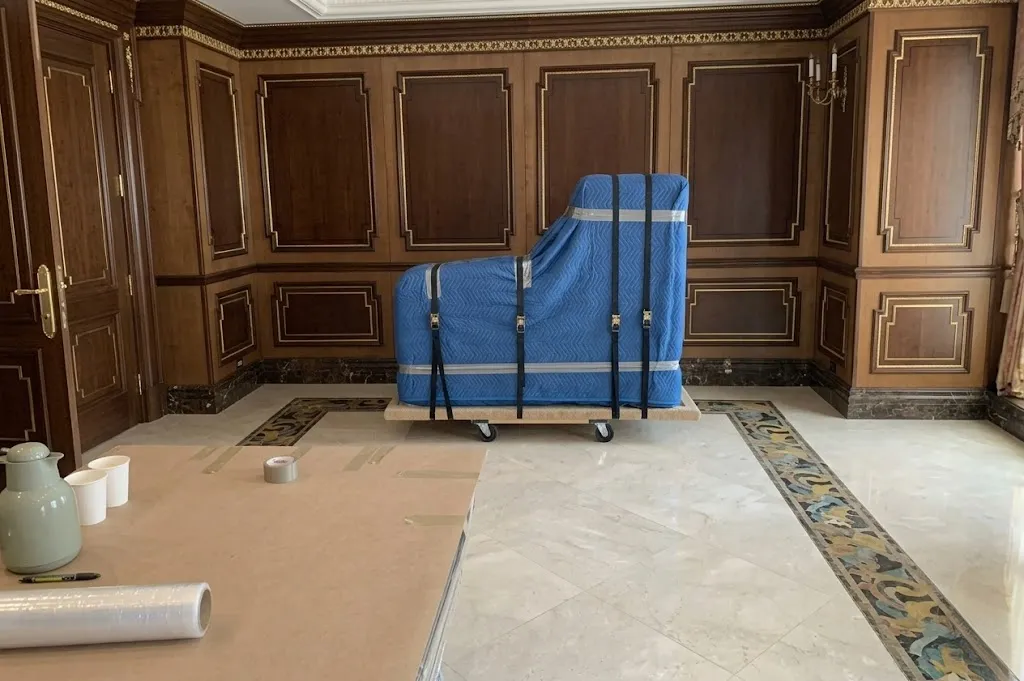
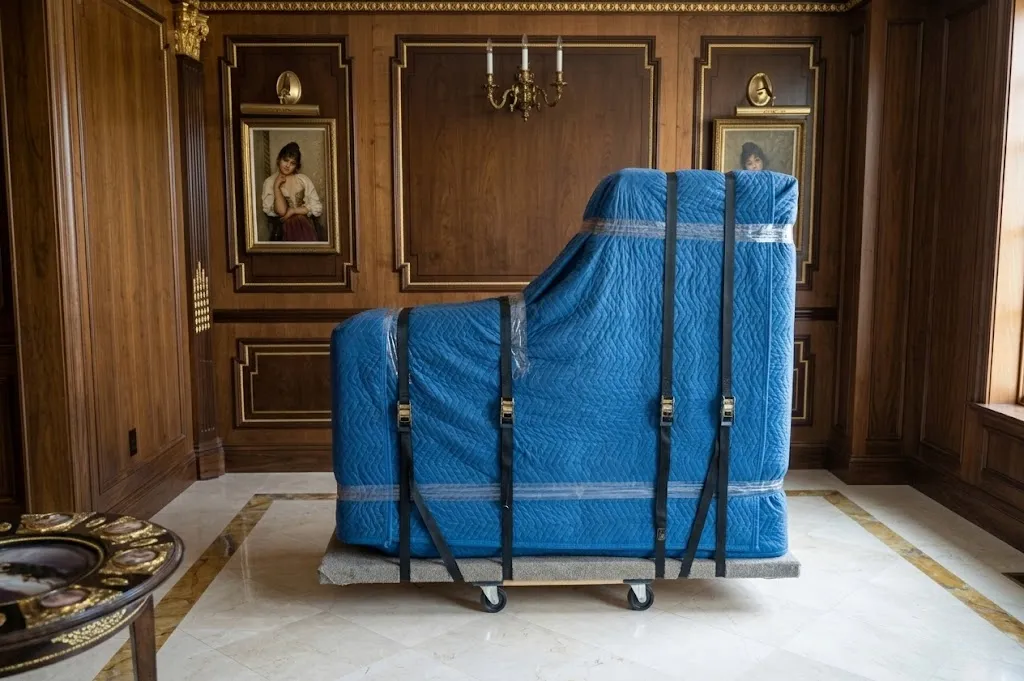
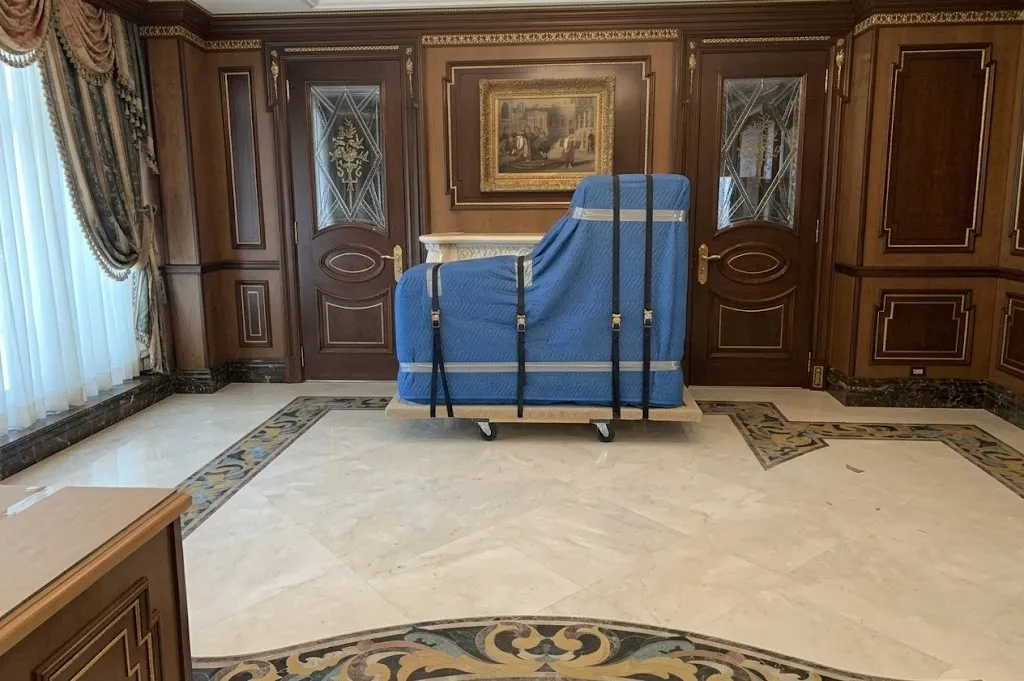
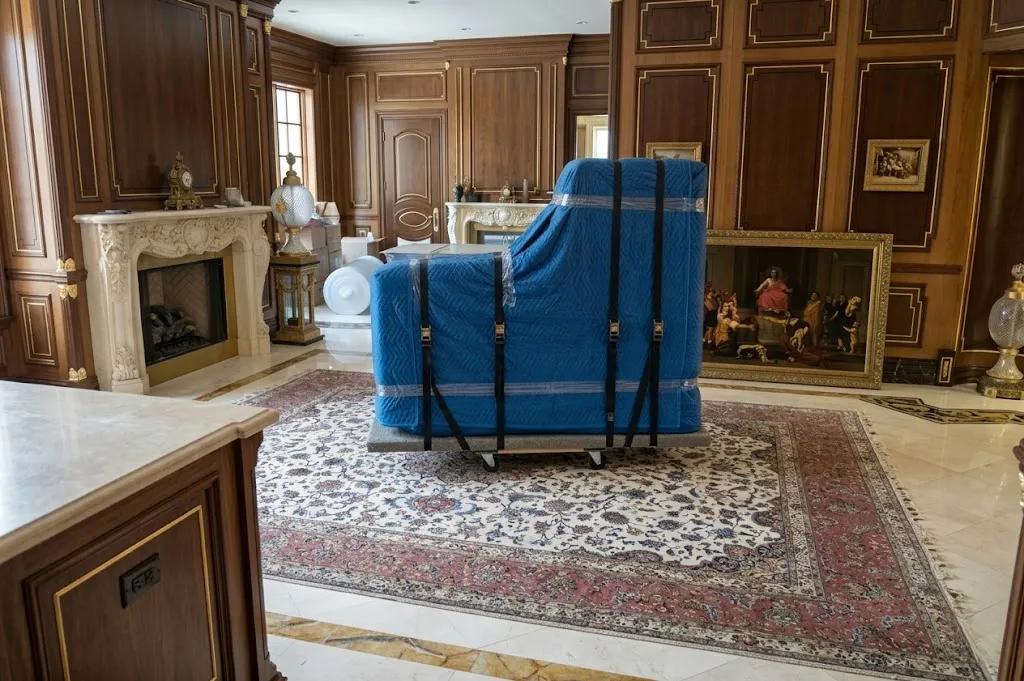
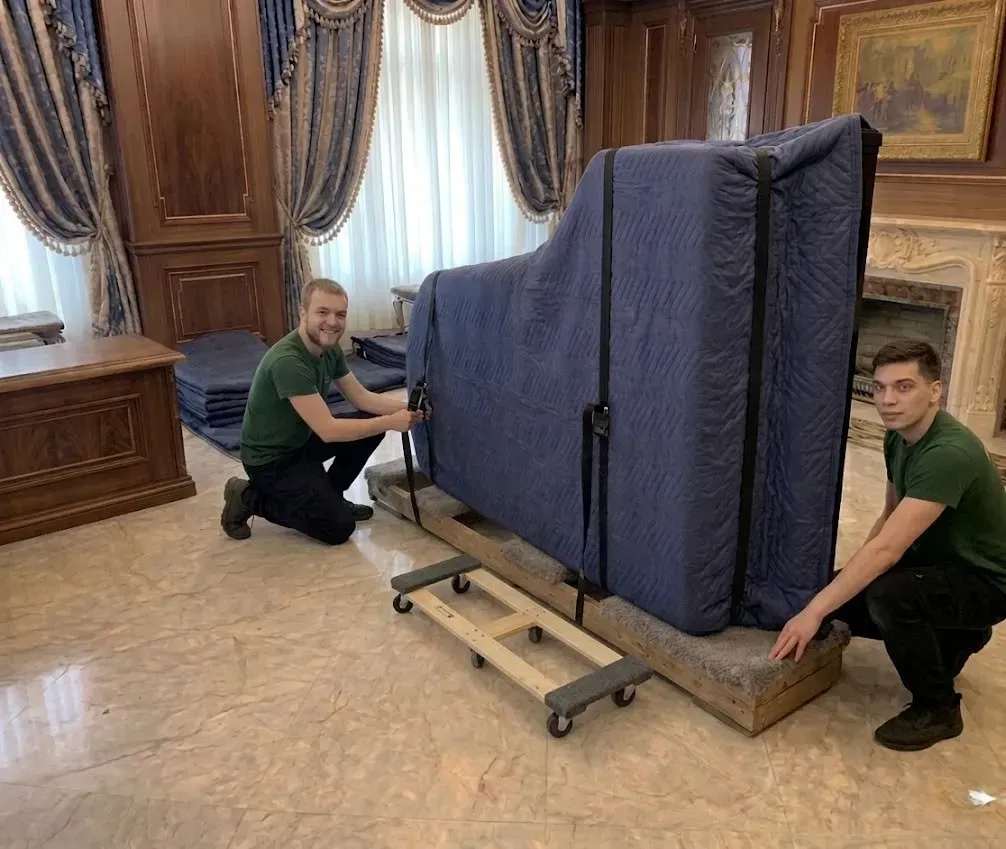
A piano board is a purpose-built flat panel constructed from high-density composite board, with integrated strapping hardware and wheels rated for instrument weight. A standard furniture dolly is not an adequate substitute. The load geometry of a piano board positions the instrument at the correct angle relative to the wheels, distributing mass evenly across the base and preventing forward tipping during lateral movement. The straps we use are rated specifically for piano weight classes, not repurposed cargo or furniture straps. Piano-specific padding differs from furniture blankets in internal fill density, which is what prevents contact damage on lacquered and polished cabinet surfaces. The distinction matters most on grands with high-gloss finishes, where furniture blanket contact leaves permanent impressions.
Grand pianos are loaded into the truck in a specific orientation based on the instrument's length and the distance to be covered. The assumption that horizontal positioning is always correct is one of the most common errors made by crews without piano-specific training. The instrument is secured against lateral movement at multiple anchor points, and padding remains on the instrument until the truck is fully stationary at the destination. Floor protection at both origin and destination includes heavy-duty runners from the entrance to the final placement location, corner guards on every doorframe the piano passes through, and door stop removal where clearance requires it. These measures are part of the standard process, not optional additions to the quoted service.
A dropped upright piano, even from a height of a few inches during a missed stair placement, can crack the soundboard. A cracked soundboard on an instrument valued at $10,000 or more renders it unplayable. Repair, when possible at all, requires a registered piano technician and costs that frequently approach the instrument's full market value. Improper leg removal on a grand piano, using a standard wrench on mounting hardware requiring a piano-specific tool, strips the threads permanently. The mounting block cannot be replaced without major structural intervention. These outcomes occur when general furniture crews attempt piano moves without instrument-specific training.
Insurance claims for piano damage are rejected when the moving company executing the move is not licensed and insured for specialty item transport. Standard general liability policies carried by most moving companies explicitly exclude musical instruments above a threshold value. The lacquered finish on a polished grand is among the most expensive surfaces in instrument restoration. A single unpadded contact point creates a pressure mark requiring full-section refinishing, not spot repair. Tuning after a structurally compromised move does not address underlying damage. A piano that has experienced a fall or soundboard crack requires assessment by a registered piano technician before any repair path can be determined.
Our team is available 9am - 9pm, 7 days a week to help plan your perfect move.
Before a crew touches the instrument, we assess the full route at both addresses. Doorway widths are measured against the piano's dimensions. Staircase angles and landing sizes are evaluated. Elevator weight ratings are confirmed where applicable. For grand pianos or any move with unusual access constraints, this assessment is conducted in person before the move date is confirmed.
The key cover is secured. On grands, the lid is locked or removed based on its hardware configuration. The pedal lyre is detached and wrapped separately. Legs are inspected for mounting condition before removal begins. On uprights, the back panel integrity is confirmed before the piano is moved onto the board.
Corner protection is applied first, covering all protruding edges and leg mounting points. The full-body wrap follows. On lacquered and polished instruments, the padding layer in direct contact with the surface is piano-specific material, not furniture blanket fabric. Every external contact point is covered before the piano leaves its original position.
The piano board is positioned with its wheels aligned to the direction of travel. The instrument is strapped to the board at rated anchor points before movement begins. Crew roles are assigned by position: one handler at the keyboard end, one or two at the rear depending on the piano's weight class, and one leading the route.
The piano is loaded and secured against lateral movement at multiple anchor points. The truck deck is padded beneath the instrument. Nothing is stacked against the piano during transit. On moves exceeding thirty minutes, securing is verified at the first full stop before continuing to the destination.
The route through the destination is confirmed before unloading. Floor runners and door frame padding are placed before the piano enters the building. Grands are reassembled in final position and the pedal lyre is reattached. A visual inspection of all exterior surfaces is completed before the crew departs. We advise waiting two to four weeks before booking a tuner.
Every piano requires tuning after a move, regardless of how carefully the instrument was transported. String tension across 200 or more strings shifts during transit as vibration redistributes load across the pin block. This is not a sign of improper handling. It is a physical consequence of relocating an acoustic instrument. Wait two to four weeks before booking a tuner. The piano needs time to acclimate to the temperature and humidity of its new environment before a tuning will hold. A piano tuned immediately after a winter GTA move, before the instrument has adjusted to indoor climate conditions, will go out of pitch within days.
Place the piano away from forced-air heating vents, exterior walls, and windows with direct sun exposure. Each position exposes the instrument to temperature and humidity gradients that cause ongoing pitch instability. We leave tuner selection to the client's preference and can recommend registered piano technicians in the GTA on request.
Move Your Stuff has been moving pianos across the GTA for over 15 years. Our crews receive training specific to piano handling, not general moving training applied to specialty items as an afterthought. Every piano move we execute is covered under instrument-specific insurance that does not carry the exclusions common in standard moving liability policies. We have moved hundreds of uprights, baby grands, parlor grands, and institutional studio pianos through the full range of GTA residential and commercial property types, including high-rise condominiums, century homes with narrow Victorian staircases, and ground-floor commercial spaces requiring ramp loading. Our clients include private families, music schools, churches, and performance venues across York Region and the City of Toronto. Clients who return to us specifically cite instrument condition on arrival and crew care as the reasons for their continued business.
Answers to the questions piano owners ask us most often before booking.
Experience a stress-free move with Move Your Stuff. Choose us, and here's what you can expect:
Initiate a personalized discussion with our friendly representatives to outline your unique needs.
Collaborate with our adept management to craft a meticulous plan, leaving no room for unexpected surprises.
Entrust your move to a team with a sterling reputation throughout the GTA, boasting years of proven experience.
Enjoy bespoke moving procedures tailored to accommodate the specific demands of commercial ventures or relocations.
Prioritization of your organizational needs as we expedite the process of getting your space in order swiftly and efficiently.
Respect for your time is our commitment; we dispatch promptly and communicate transparently, ensuring minimal disruptions.
OUR SERVICE AREAS