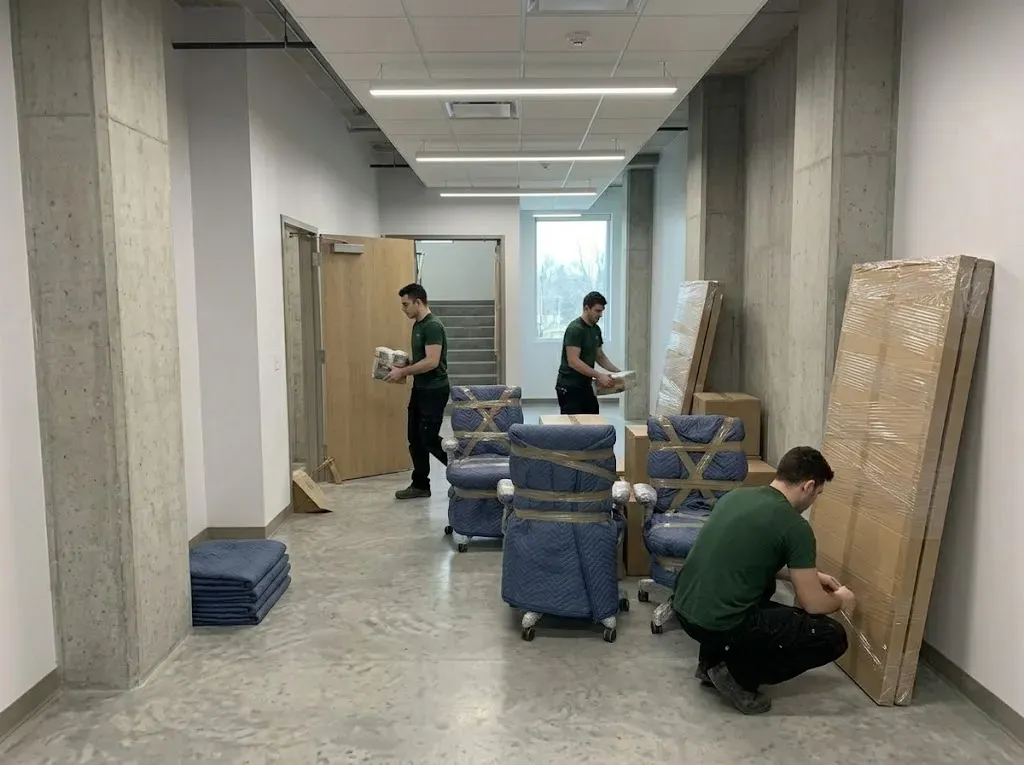
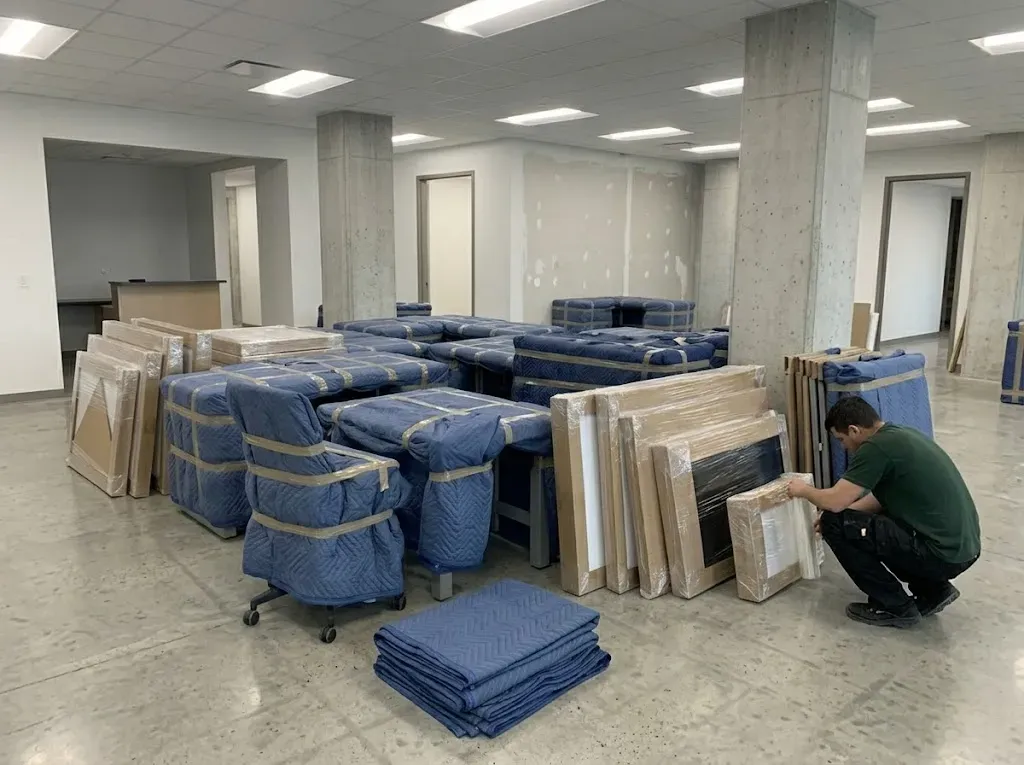
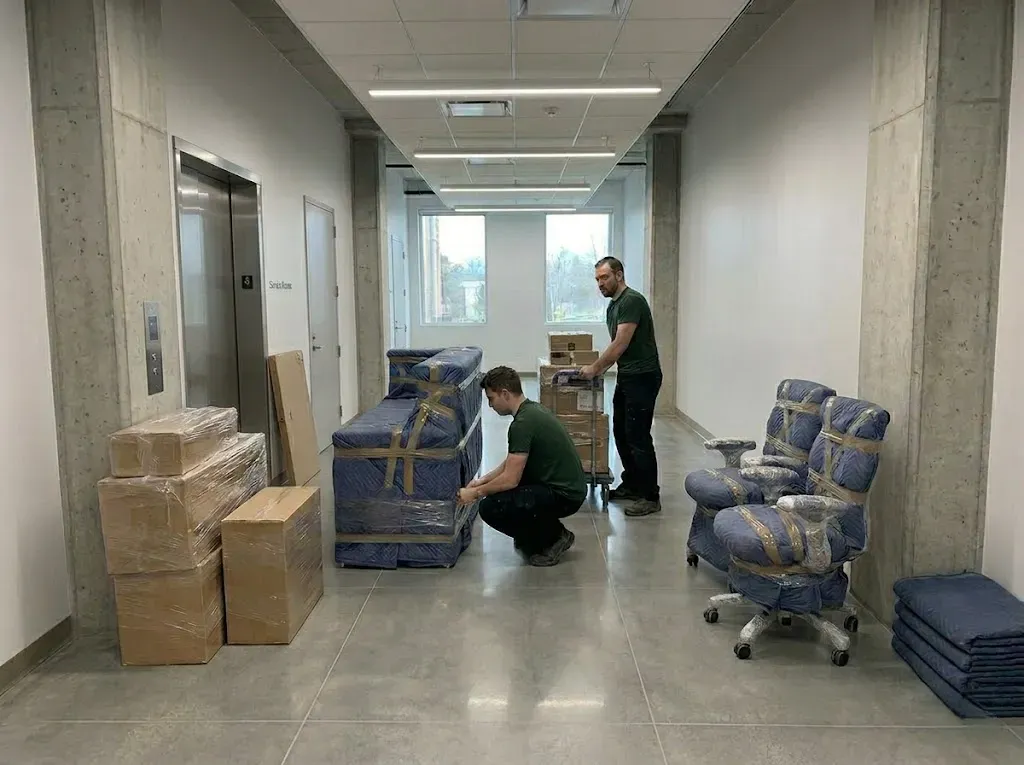
Every hour a business cannot operate during a move is billed revenue it will never recover. Unlike a residential relocation, where the primary risk is a damaged piece of furniture, an office move creates measurable financial exposure the moment it runs over schedule. Most commercial relocations are executed after business hours or across weekends for exactly this reason. The window between Friday's close and Monday's opening is the only time most businesses can absorb a full transition without client-facing disruption. That constraint requires a crew trained and scheduled for overnight and weekend work, not one that treats after-hours access as an inconvenience. For a 15-person firm, a single day of lost productivity across the team is a real dollar figure that can exceed the entire cost of the move.
Client files, HR records, financial documents, and legal materials require sealed boxes, proper labelling, and a documented chain of custody from origin to destination. Commercial properties add a separate layer of operational complexity. Loading docks operate on strict booking windows, freight elevators require advance reservation, and after-hours security access must be arranged with building management at both locations well before move day. Unlike a residential move where a single person makes every decision, office moves involve management, IT, facilities teams, and often landlords at both ends. Each carries its own access requirements, insurance thresholds, and approval processes that must be resolved before a single item is loaded.
From a compact four-person suite to a multi-floor corporate headquarters, every scale of commercial relocation requires a different plan, crew size, and execution sequence.
One to ten people in a single room or compact suite typically moves in a single day. We arrive with the right crew size, a clear labelling protocol, and a destination floor plan so staff return to a functioning workspace.
Ten to fifty-person offices on a full floor or multi-room suite require an advance walkthrough to scope volume, sequence department moves, and identify IT complexity. Phased execution keeps part of the team operational during the transition.
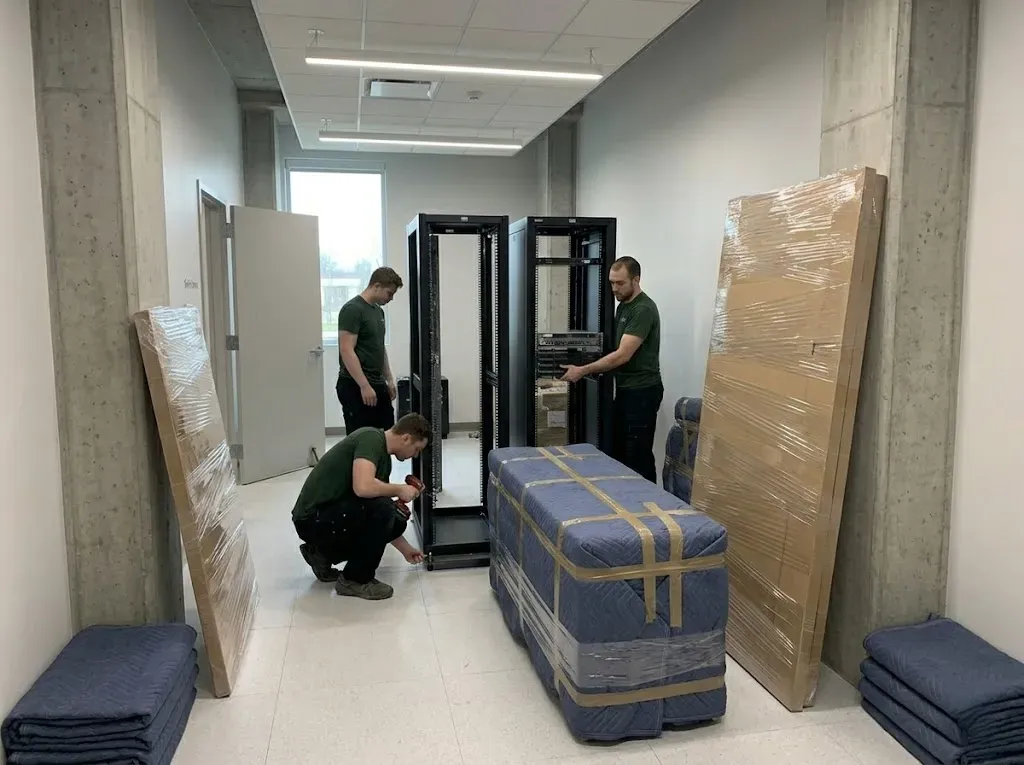
Tech companies, financial services firms, and legal practices require anti-static packaging for servers, individual box packing for monitors, and a cable labelling system that makes IT reconstruction predictable rather than a half-day of guesswork.
Patient records and healthcare equipment carry specific handling requirements. We coordinate with your compliance team to confirm records are sealed, logged, and transported with chain of custody intact throughout the move.
Display fixtures, POS terminals, and inventory follow a different loading sequence than standard office furniture. Fragile display items and high-value equipment are factored into the packing plan and load configuration from the start.
Reconfiguring workstations or moving departments within the same building demands the same planning discipline as a full relocation. The absence of a truck route does not reduce the complexity of the labelling, sequencing, or reinstallation.
Office moves fail most often before the crew loads the first item. A move that has not been properly scoped produces a crew that arrives without enough truck capacity, the wrong equipment configuration, or no clear understanding of what goes where at the destination. Without a pre-move walkthrough, volume is consistently underestimated. Offices accumulate years of files, equipment, and furniture that nobody inventories until move day. When boxes are labelled only as "office," unpacking becomes hours of search work. Staff spending their first morning back locating their own equipment is lost productivity multiplied across the entire headcount. A proper pre-move assessment closes all of these gaps before they become problems on move day.
Commercial buildings in downtown Toronto enforce freight elevator and loading dock windows with no exceptions. A crew that misses its window faces a move that stalls, accumulates overtime costs, and may lose building access entirely for that day. IT equipment mishandled in transit, including servers transported without anti-static protection, monitors stacked without individual wrapping, or cables disconnected without labelling, creates IT reconstruction time measured in days rather than hours. Our pre-move assessment confirms building access windows in advance, establishes IT handling protocols before the crew is dispatched, and documents a contingency approach for destination delays or unexpected equipment complications so none of these scenarios unfold without a plan already in place.
Before a single cable is disconnected, your IT environment is assessed and mapped. Items that require your internal IT team to handle, such as active server configuration, proprietary hardware, or systems under vendor warranty restrictions, are identified at the walkthrough. The boundary between what our crew manages and what your team manages is established in writing before move day. Monitors are packed individually in dedicated boxes with full padding. Laptops and screens are wrapped separately. Servers and networking equipment are transported with anti-static protection and staged at the destination in the correct room before unpacking begins. Every cable connection is labelled before disconnection so your IT team reconstructs the environment from a documented state rather than from memory.
Client files, HR records, financial documents, and legal materials are packed in sealed, labelled boxes and logged at origin. Nothing in those categories moves without your explicit sign-off on what is included in the scope. Boxes are delivered to the correct destination room and remain sealed until your team opens them. Items that your legal or compliance team must take personal custody of, such as litigation files, regulated financial records, or materials subject to specific chain-of-custody requirements, are flagged during the consultation so the handoff is deliberate and documented, not left to move-day improvisation.
Our team is available 9am - 9pm, 7 days a week to help plan your perfect move.
An after-hours move begins when the last employee leaves. The target is a fully operational office before your team arrives the next morning. This means a crew arrival in the early evening, systematic floor execution, and destination setup completed well before the standard 8 or 9 a.m. start. Weekend moves, particularly Friday-close to Monday-open transitions, follow a structured sequence. Packing is confirmed by Thursday, the crew is briefed on access credentials and floor plans, execution continues through Saturday, and Sunday is reserved for destination setup and punch-list resolution. For larger offices where a single-weekend window is not sufficient, phased department transitions keep part of your team operational while the rest of the organization moves. The client's pre-move responsibilities, including IT disconnection, personal item labelling, and access credential handoff, are defined precisely in advance so move day runs without waiting on decisions that should have been made earlier.
We walk both origin and destination spaces to assess volume, identify IT complexity, map the destination floor plan, and confirm building access requirements. The output is a documented move scope, not a verbal estimate.
Department sequences are set by operational priority. Teams that must be live first are moved last to minimize their downtime window. IT equipment handling is integrated into the sequence, with the client-IT boundary established in writing.
Every box, piece of furniture, and IT item is tagged with a destination code tied to the floor plan. Nothing leaves the origin building without a placement instruction. The destination layout is confirmed with the client before move day.
Freight elevator windows and loading dock slots are booked at both locations. After-hours security access is confirmed with building management. Parking permits for commercial districts are arranged where the building or municipality requires them.
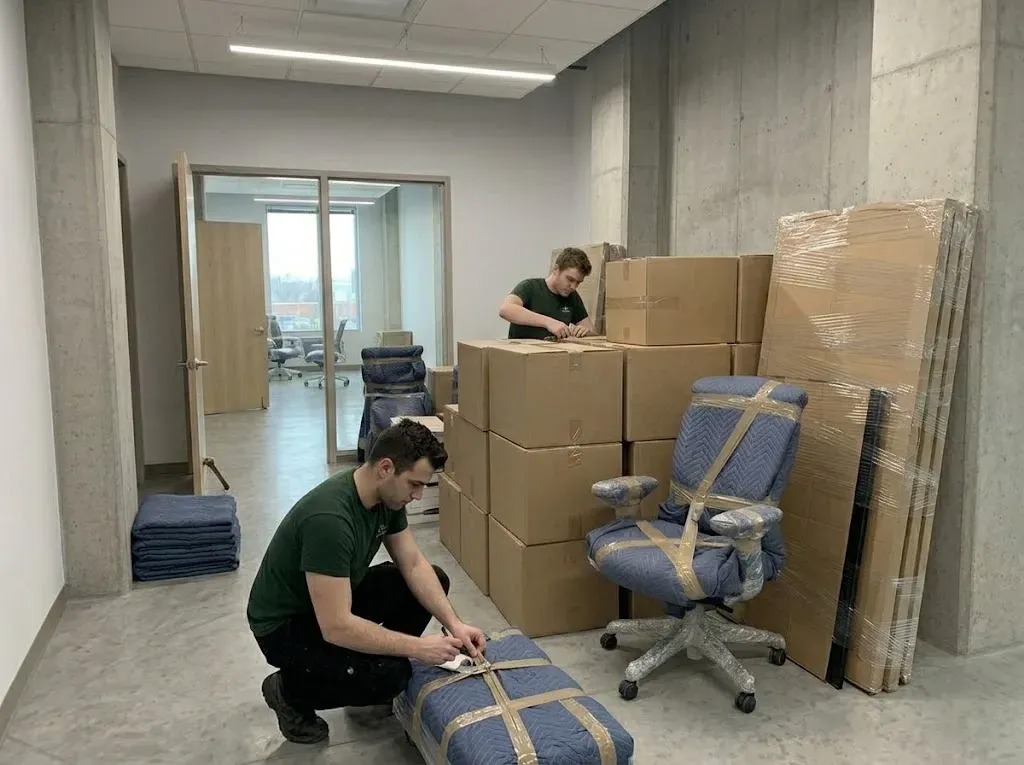
The crew arrives with the floor plan, the labelling key, and a time sequence. Shared corridors and lobbies are protected. The freight elevator schedule is managed by a crew lead to prevent window violations and keep the sequence on time.
Workstations are reassembled per the destination floor plan. Boxes go to the correct desk. Furniture is placed per the confirmed layout. Before the crew leaves, the destination is checked against the floor plan and punch list items are resolved on-site.
A residential moving company that accepts an office contract typically has no protocol for commercial loading dock access, no procedure for freight elevator windows, and no crew briefed on after-hours building conduct. The move runs past the building's access window, overtime accumulates, and the client absorbs costs that were never part of the original quote. Commercial landlords across the GTA require proof of insurance with liability limits well above residential thresholds. A mover that cannot produce a commercial certificate of insurance is turned away at the building entrance. This stops the move entirely and forces the business to absorb the full cost of a failed relocation day.
A server dropped by an uninsured crew creates replacement and data recovery costs that can dwarf the entire moving contract. Monitors damaged in transit mean hardware replacement plus the time cost of sourcing and configuring new equipment before staff can work. Client files and HR records transported in open, unlabelled boxes without chain of custody create legal liability for your business, not the mover's. That liability follows your organization. For a 20-person office where every employee spends their first day back locating equipment and reconstructing their workspace, the productivity loss alone represents 20 full working days absorbed in a single morning.
Answers to the questions business owners and office managers ask before committing to a commercial relocation.
Experience a stress-free move with Move Your Stuff. Choose us, and here's what you can expect:
Initiate a personalized discussion with our friendly representatives to outline your unique needs.
Collaborate with our adept management to craft a meticulous plan, leaving no room for unexpected surprises.
Entrust your move to a team with a sterling reputation throughout the GTA, boasting years of proven experience.
Enjoy bespoke moving procedures tailored to accommodate the specific demands of commercial ventures or relocations.
Prioritization of your organizational needs as we expedite the process of getting your space in order swiftly and efficiently.
Respect for your time is our commitment; we dispatch promptly and communicate transparently, ensuring minimal disruptions.
From Markham's Highway 404 tech corridor and its concentration of mid-size software firms to Vaughan's Highway 400 industrial strip and North York's Yonge-Sheppard commercial core, each business district presents distinct logistics for freight access, COI requirements, and after-hours coordination.